


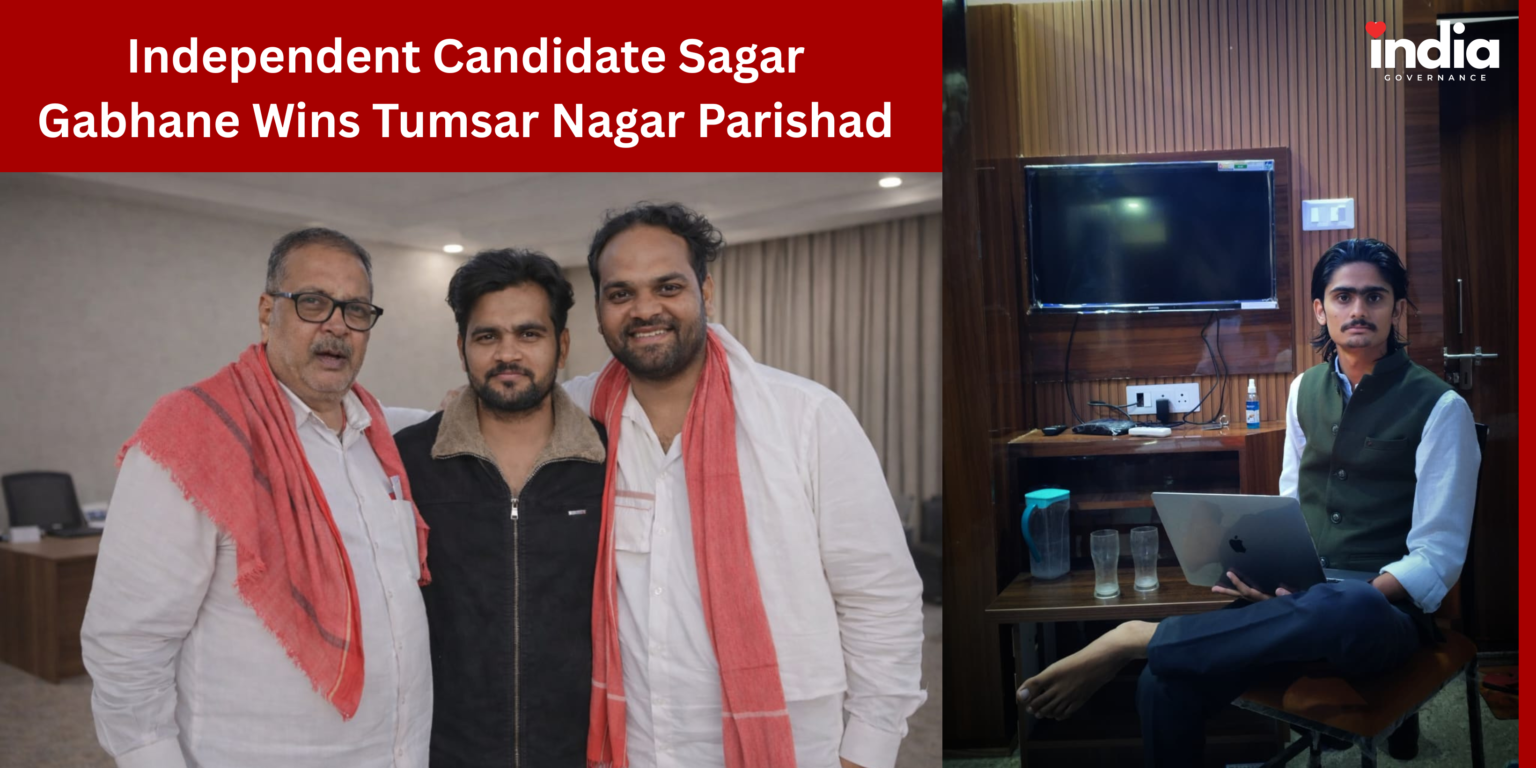
In the Maharashtra Nagar Parishad elections, the most surprising outcome emerged from Tumsar, where independent candidate Sagar Gabhane defeated candidates of major political parties to win the post of Nagar Parishad President. The seat, considered one of the most high-stakes constituencies in this election, witnessed competition from the Nationalist Congress Party (NCP), Bharatiya Janata Party (BJP), Congress, and Shiv Sena.
Despite massive campaigning by heavyweight leaders including Maharashtra Chief Minister Devendra Fadnavis and senior leader Praful Patel, the final result turned the political narrative upside down. The unexpected victory of an independent candidate without the backing of a major political party has now become a talking point in the state’s political corridors.
1️⃣ High-Voltage Political Turf: Major Parties Shocked by Independent Candidate’s Win
Tumsar was viewed as a prestige battle for multiple parties due to its geographical influence and voter segmentation. The presence of prominent campaigners, large rallies, strategic messaging, and aggressive booth management hinted at a direct contest between BJP and NCP. However, Gabhane’s win redefined the political expectations.
What appeared to be a traditional multi-party fight gradually turned into a personality-driven campaign, where the voter’s trust outweighed the political brand value of leading parties. Gabhane’s public perception as a local face, accessible leader, and community-centered representative helped shift the voter sentiment.
For many analysts, the election’s outcome underlined a message—
the electorate is beginning to choose individuals over political symbols, performance over promises, and credibility over campaign optics.
2️⃣ The Strategy Behind Success: Research, Planning & Targeted Execution
Reports suggest that the victory was not accidental but the result of a structured and professional political operation. The campaign strategy was led by political strategist Devendra Shivhare and his consulting firm Political Agents, which played a crucial role in data-based planning and field execution.
The team conducted extensive research across Tumsar, identifying voter behaviour patterns, local dissatisfaction points, ward-level issues, and the emotional expectation of the electorate. Based on this, a campaign blueprint was developed focusing on local issues rather than national rhetoric.
Key elements of the strategy included:
-
Grassroots-based ward mapping
-
Issue-focused communication instead of party-centric slogans
-
Door-to-door personalized outreach
-
Identifying silent voter groups and converting undecided voters
-
Controlled campaigning instead of high-budget rallies
-
Micro-targeted messaging for specific voter demographics
This systematic use of research, sentiment analysis, and ground-level engagement shifted the election momentum in Gabhane’s favour.
3️⃣ Door-to-Door Outreach Became a Turning Point
Instead of large rallies and loud political displays, the campaign emphasized face-to-face voter connection. Volunteers strategically visited households, community clusters, market areas, small businesses, and neighbourhood zones to build a trust-based narrative.
While big parties amplified speeches and optics, Gabhane’s campaign built emotional connection. The message was direct, relatable, and focused on civic needs such as:
-
Water supply issues
-
Internal roads and sanitation
-
Administrative neglect
-
Small business and local trader concerns
-
Ward-level representation
This practical and hyperlocal approach resonated with voters who felt disconnected from traditional political campaigns. The line adopted by the campaign —
“This election is not about parties, it’s about your rights.”
became a psychological anchor for the public and a recognisable identity for the candidate.
4️⃣ A Case Study for the Future: Strategy Over Strength
The Tumsar victory has now started being cited as a reference model for modern Indian electoral politics. It highlights how professional strategy, voter research, social psychology, data-driven targeting, and ground execution can defeat resource-heavy campaigns.
The election outcome reflects a larger shift:
-
Voters are demanding accountability and clarity
-
Big rallies don’t guarantee trust
-
Data and on-ground insight are replacing guesswork
-
Independent candidates can win with strong planning
Political observers believe that this model will influence upcoming local body elections and may inspire independent candidates across different states to opt for structured professional electoral management. In Tumsar, this win stands as a practical demonstration that research + strategy + execution = electoral victory.